Posts

Presentation

 My presentation is in google slides, it can be found here .

Website and Business Card Redesigns

Image
 I originally designed both my business cards and website quite quickly last year, I made them initially just to have something more professional to show to people at the events I was attending, and also to make myself more appealing to event organisers when applying for markets and conventions. I used imagery that I had to hand at the time, and was happy with how it turned out, but I have since redesigned my website in order to better reflect the ideas and aesthetics of my handmade accessory brand  Below are some screenshots of my website before reworking it, you can find it in it's current rendition here  it's still very much a work in progress and will probably continue to change and evolve as my practice does. Also below are images of my redesigned business cards, I'm currently waiting on these to be printed and delivered.

Website and social links

Website Instagram Depop Etsy

Professional Practice Report

Rebecca East Professional Practice Report. Throughout this module, and over the past year or so outside of study, I have spent a lot of time developing not only my practice as an illustrator but also the small business I have recently started. I began making prints of my artwork alongside small handmade accessories last year and selling these at events like art fairs and conventions across the UK, I’ve found a decent amount of success with this so far and intend to continue this into the future. My main focus professionally has been on marketing and selling my handmade works online and at events. I started quite small with this, taking part in a few small local events alongside other students, and from that I grew the confidence to start selling as an individual. Over the past 8 months I have sold my work at over a dozen events across the UK, including CMYK Festival, Bath Craft and Flea, Brixton Create Showcase and Outertown Festival, and I have more, larger events upcoming like Bristo...

Evaluative statement

  Rebecca East Process and Practice  Evaluative Statement Throughout this project looking at the theme of ‘Poetic Science’ I wanted to explore the intricacies of mushrooms and mycelium, finding ways to illustrate the complex ecology of these species, while also looking into more fictional mediums like fantasy and fairytales, where fungi imagery is often used. In my initial research I started reading ‘Entangled Life’ by Merlin Sheldrake, which expanded my knowledge of not just how many species of fungi there are but also in how they shape the world around us in many different ways; this made me realise that I would need to narrow my focus away from fungi as a whole, as the topic is far too expansive to cover in a single project. I took inspiration from some places I visited on a trip to Berlin last year, where scientists and artists have looked at specific use cases for certain fungal species and decided that focusing on individual species and looking at them in more det...

Trying and failing to grow my own mushrooms

Image
 When I first started researching fungi and looking into different species of mushrooms, the first species that interested me and gave me some inspiration for potential work was the Shaggy Mane Ink Cap. These mushrooms not only look quite interesting with their feathered-looking caps but also act in a really peculiar way; they naturally produce a black ink-like substance as they decay, and they decay pretty quickly.  Naturally, when I learned of this fact, I was absolutely enamoured by the idea of making my mushroom-based project and drawing all of these mushroom sketches using entirely mushroom ink. After some research I found that Shaggy Mane ink is not an easy nor cheap thing to source, however shaggy mane spores to grow your own mushrooms are much easier to come by, even if it meant buying them from a dodgy website that seemingly hadn't been updated since 2015. So I bought my spores from that dodgy website and a grow bag kit on Etsy and thought "how hard can it be?". ...

Futurium Museum

Image
 During a trip to Berlin last summer, I visited the Futurium Museum, and one exhibition called The Outside Inside by Johanna Schmeer particularly held my attention. This exhibition looks at the idea of biology and technology becoming increasingly intertwined, and the potential issues and possibilities of blurring these lines even further.  The main part of the installation is a futuristic garden wherein plants and fungi are encased in terrariums. The specific plantlife and fungi in the terrariums were chosen for their different terraforming abilities. Some of the domes contain Amaranth, " which can grow and sequester carbon dioxide in saline and dry conditions, removing a small amount of salt from the ground in the process" others contain oyster mushrooms " which have the ability to remove heavy metals and other contaminants from their environment, preparing it for other species." (quotes taken from the  Futurium website ) The part of the installation that I found m...

TopLab

Image
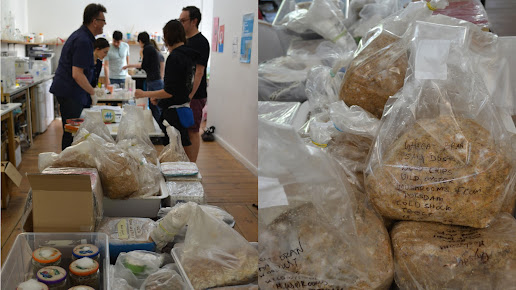
 During a trip to Berlin last summer, I was fortunate enough to visit The Transdisciplinary Project Space or 'TopLab'; a facility in the city centre which works as a collaborative working space between artists and scientists. Here they work together to creative inventive solutions to modern day issues, particularly around sustainability.  When I visited, the majority of their work was currently revolving around the use of fungi as a material for production and construction. They showed us how fungi can be grown in moulds to make things like packing material for shipping and even bricks and panels for insulation in buildings.  We were toured around the lab and project space, a space that perfectly exemplified the idea of 'poetic science' as art materials and lab equipment lined the shelves and concept design sketches drawn up by the resident artists covered the walls. We were also shown the growing space in the basement; a cool dark room where large grow-bags filled with...

Fungi and Mushrooms in Folklore

Image
 I'm interested at looking into the use of fungi and mushroom imagery throughout folklore and fairytales. I want to see if there's any room for crossover with the more scientific based research I've done. Mushrooms make a lot of appearances in fairytale imagery and historically they've had lots of different meanings and significance to different cultures, exploring these ideas could lend me some new inspirations for my own work. I think a good example of these potential for this crossover of science and folklore comes from Fairy Circles; the name given to a perfect circle of mushrooms that grows commonly in forests during the summertime. In British folklore these circles were the spots where fairies would dance after a rainstorm, and people were warned not to enter them as humans would fall into a hundred year sleep if they did.  Scientifically speaking, we now know that these circles form due to the pattern of growth of the mycelium below the surface. The fairy circle ...

Process and Practice

Research: Fungi in Folklore TopLab Futurium Museum Trying and Failing to Grow My Own Mushrooms Evaluative Statement

Anthology group work 'The Unseen'

Image
For our anthology asignment, my group and I decided to look at the theme of visions of the future, in response to the brief of 'The Unseen'. As well as sharing the same over-arching themes, we also wanted our stories to have aesthetic coherence in the zine, so we decided to stick to a mostly monochromatic colour palette with accented use of colour. I created a short story exploring the idea of remote warfare, and toyed with the idea that in the future conflicts could be conducted like video games, like a very exaggerrated version of the kind of drone warfare currently used today. I wanted to create an image of the future where people fighting in wars are so detatched from their actions that they treat the very real people and place they're attacking as if they're just enemies in a video game with no real consequence.  I also made the cover for our zine, it's supposed to depict TV screens with distorted ad abstract references to the content of our stories on them.  

Final outcome development

Image
After the first few workshops of the module, I knew I wanted to create a 3D piece inspired by the work of Fraces Glessner Lee, and I was very excited about the idea of making a large scale dollhouse depicting come kind of macabe scene.  I've worked with 3D miniatures and dioramas before and thoroughly enjoyed it, but I'd never made something on this scale, so I was very excited about the prospect but had a lot of logistical aspects to work out first. I looked at a few different artists and representations of dioramas for inspiration and insight into how to portray these kinds of scenes. Being a horror fan, the miniatures used in the film 'Hereditary' instantly came to mind as a reference not only for constructing dioramas, but for how they can be used to strengthen certain narratives in film and photography. Initially I planned on building the house myself, as I had a certain layout of rooms in mind that I thought I would need to construct myself to achieve, however I f...

Final Outcome

Image
 Below is a photo-tour of my final outcome. I made a dollhouse depicting a crime scene in a family home. The wooden dollhouse was purchased online and then painted and furnished by myself. All of the details including wall coverings, floorings, furniture and decorations were made by me.  I ended up deciding against putting any figures into the house as I wan't to create the idea of a crime scene that the viewer can 'investigate' and piece together small details to decide what they think may have happened. I think this is a much more interesting and engaging narrative device than simply having a scene being acted out by figurines, which was my original idea.